Popular Posts

Saturday, December 3, 2011

Rising Rates of Unemployment

(Due Date - Tuesday, 17th January, 2012 - Unemployment)

Unemployment rates in Canada has been raising recently due to many reasons. According to the Winnipeg Free Press, recently, in Quebec, services jobs ditched a big 18,600 workers who were part-time employees. This has not only been happening in Quebec, but in other provinces as well. Manitoba has also let go of 6,500 part-time jobs in the past one month, which pushed the unemployment rate from 5.2% (October) to 5.5%.
Statistics Canada showed that there were at least 212,000 more Canadians working last year in 2010 at the this time than there is now, which is a huge difference. In my opinion, laying off part-timers may be beneficial to the company, but it is very unfair for the part-timers, as I would 99% be a part-timer as well if I were to be hired. It is already starting to get harder getting jobs, and people are laying more and more people off their part-time jobs, which is really unfair. All these laying off is creating a large handful of Canadians who are attempting to earn money for a living, or to pay rent or pay educational fees. So firing the part-timers may be effecting other aspects of their lives as well, but of course, the companies do not pay attention at all to these other negative side-effects.

In conclusion, due to the sudden laying off of people during this time of year, has caused the Canadian unemployment rate to jump from 7.3% to 7.4%, which is a big jump within 1-2 months.

Canada's Economic Prosperity

(Due Date - Tuesday, 10th January, 2012 - Economic Prosperity)

As a Canadian citizen, I truly believe that Canada would be on one of the top ten lists of countries that are economically prospering. Canada's vast raw resources such as lumber and water gives us a big bargaining advantage, as every person in the world needs fresh water.

A list created by Legatum Institute called the (2011) Legatum Prosperity Index, Canada ranks 6th in the entire world behind Norway, Denmark, Australia, New Zealand, and Sweden in 1st, 2nd, 3rd, 4th, and 5th places respectively. The statistic brings in count not only economic stability, but other related topics such as the governance, education, safety/security etc. of the respective countries.
Canada is within the Top 10 ranking.

As a Canadian citizen, I do believe that Canada's economy is very stable, at least for the time being. Albeit the crisis in Europe, Canada seems to be standing strong, and also against a few bad choice made by the U.S. in the past years, Canada has been able to hold off most negative experiences the world has thrown at us. In addition to that, as said before, the fact that we hold the largest supply of fresh water, and a great amount of wood/lumber for trade, it makes the Canadian economy flourish. Canada is also very service-based, and that is also contributing towards the success the Canadian economy has achieved.

Economic prosperity also surrounds the income of Canadian citizens, and at the time, it seems that everyone has more than enough income to provide for their families, but this does not mean every Canadian citizen has enough, although we have a good stable economy, there is a handful of people who are homeless across Canada's major cities such as Toronto. Despite the recent Y.R.T. and VIVA strikes causing a void on a portion of the Yonge Street in the rural areas in Aurora, and Richmond Hill, there have been alternatives to deal with it. Jobs are relatively easy to find in Canada, depending on what skills, assets and traits you hold.

In the end, I believe the Canadian economy is very stable in the mean time, but I have no opinions or predictions on what might or could happen in the near or distant future, and with the present economic stability, Canada does indeed have a prosperous economy. Also, with the expansion of Canadian economy to the large Asian market, it will mean that Canada will rely less on the U.S., and therefore if the U.S. ever falls into recession again, Canada has higher chances of not being effected by it, or at least not effected by it as much as we could have been if we were highly reliant on the U.S..

Europe's Big Debt

(Due Date - Tuesday 13th December, 2011 - Business Ethics)

 The European community, namely the European Union, has encountered a debt crisis recently, and is still going at it. In 1992, the European Union signed Maastricht Treaty stating that they will keep a limit on their deficit spending and debt levels. A number of E.U. states, such as Greece and Italy have broken those rules they've pledged to by masking their deficit and debt levels from the entire European community through the use of complex complex currency and credit derivatives structures.

I will be unable to describe in detail what the techniques were exactly, as I am unfamiliar with them. These techniques were created by prominent U.S. investment banks who received fees for their services in creating these structures for the E.U. community. They were legally protected when the crisis broke out publicly, and therefore avoided (for the time being) any charges towards them.
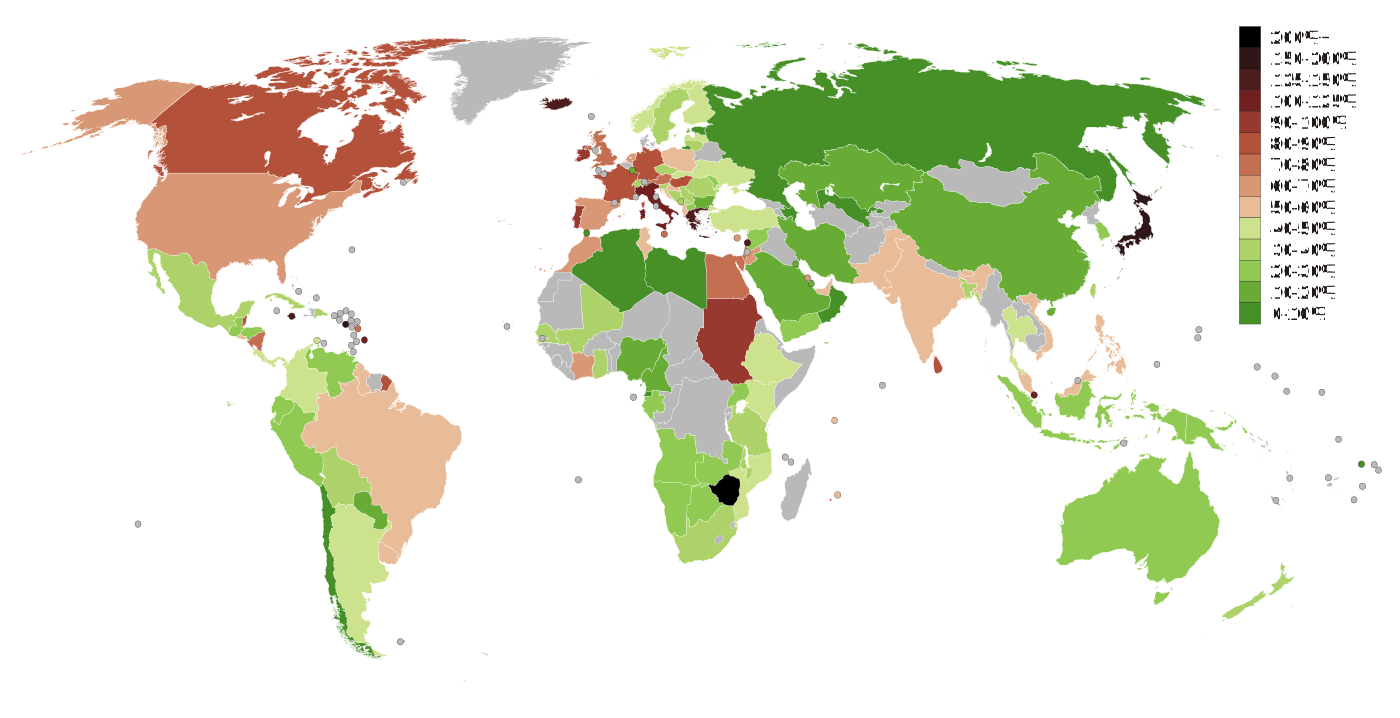
The European Union zone is a cluster of countries with high-debt percent.
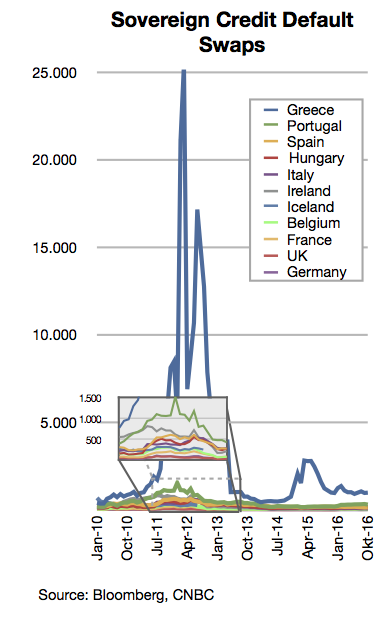
Greece's gigantic leap.
The crisis itself is a result of violation of business ethics. The breaking of the Maastricht Treaty by numerous countries was the direct violation of business ethics. They sneakily masked their deficit and debt levels as explained above, and that alone has caused the downfall of an entire economy. There are two different violations, the breaking of the treaty is the violation of the treaty, and the act of actually masking the deficit and debt levels are the true business ethic violations. It is also how many of the countries that make up the E.U. actually used these techniques, but such countries that are heavily in debt right now, or were in debt that were part of the European Union were: Ireland, Greece, Portugal, Spain, Italy, France and Belgium. It is stated by the U.K. that the domino-effect of this crisis could easily spread to the United Kingdom, and that the U.K. should not rule out the fact they are at risk as well. In addition to that, the crisis has touched Switzerland and Iceland as well.
All the countries have now (2011) dropped way below 0 and into the negatives, especially those part of the European Union.

Nokia's Big Bet

(Due Date - Tuesday 6th December, 2011 - Opportunity Costs)

Nokia has been the world's largest selling mobile phone company for a very long time. Recently, it has declined in countries such as Canada, U.S.A. lagging behind Apple, Android, and R.I.M., but their presence is still strong in Asia.
The Nokia 500 using the aging OS: Symbia
Nokia phones have been using a rather aging operating system (OS) called 'Symbian'. It has been one of the major reasons why Nokia has been lagging behind the larger mobile phone giants such as Apple, Anroid, and R.I.M. R.I.M. has updated their Blackberry cellphone lines to compete with the revolutionary Apple iPhone/iOS along with the second place Android iOS. Many phone companies have shifted to the use of the Android iOS, ditching Symbian, such as Samsung and Motorola.

Nokia has had a few choices: stick to Symbian, keep on working on Meego OS (a Linux-based OS which is fantastic and modern-looking) and eventually use Meego to replace Symbian phones, and drop both the aging OS Symbian, and the Linux-based Meego development. Nokia has created only one official phone on the Linux-based OS, and it was rather a success, but rather than relying on the new success and original OS they've created, they partnered up with the near-forgotten Microsoft's Windows Phone 7 OS.
The only Linux-based Meego OS phone released by Nokia (limited supplies), the Nokia N9.

This move is highly related to opportunity costs, as Nokia gave up 1.) the (continued) use of the aging Symbian OS, and 2.) (the more better choice in my opinion) the (continued) development, and use of the Linux-based Meego OS. The Meego OS is very impressive and sleek, compared to the Symbian. It is out of the question to keep on using Symbian OS, but the real question was, to continue Meego, and use it to replace Symbian, or simply take the quick and easy way out by partnering up with Microsoft and their some-what dying Windows Phone 7 OS.
The Nokia Lumia using the Windows Phone 7 OS.

As a fan of Nokia phones, I definitely think Symbian is lagging behind other OSs, but at the same time, I believe that Nokia's choice of switching fully to, and fully relying on Windows Phone 7 may be their biggest mistake of all, even bigger than keeping Symbian going, as it lacks originality. I personally think the continued research and development on the Linux-based OS Meego, was probably the best choice. Nokia would have created a very modern-looking, sleek, and smooth OS with a great interface. By partnering up with Microsoft, they have thrown away Meego (one of the better choices) as well as the other less viable option of keeping Symbian OS.